Australia and New Zealand’s Cold Chain Running Out of Room: Building Capacity and Resilience with Automation
By: David Rubie, Dematic ANZ Sales Director, Integrated Systems and Mobile Automation
Australia and New Zealand’s (ANZ) cold chain sector is experiencing one of the sharpest demand surges in decades. Frozen categories continue to rise as consumers seek value, meal-kit and online grocery services are expanding deeper into regional markets, and pharmaceutical and export volumes show no sign of easing.
Global forecasts illustrate this upward trajectory. By 2030, the refrigerated warehousing market is projected to reach US$427 billion, growing at more than 18% annually, with Asia Pacific outpacing every other region, according to Grand View Research.
Despite the ANZ region playing a central role in this growth story, capacity across the region is already tight – and it’s getting tighter. The question confronting industry leaders now isn’t whether demand will keep climbing, it’s figuring out how and where the sector will find the capacity and resilience to handle it.
For ANZ, the challenge has shifted from simply meeting demand. It’s now about managing it within tightening infrastructure, labour, and cost constraints. Development timelines remain lengthy, skilled labour is increasingly hard to find, and regulatory and land-use complexities make expansion difficult. As a result, operators are being pushed to consider new ways to increase capacity and maintain reliability across the supply chain.
What’s driving demand?
Consumer behaviour across the region has been changing in recent years. Economic pressures have driven stronger preference for frozen and ready-to-eat categories, with frozen fruit and vegetables among the fastest-growing segments. This is contributing to more stock keeping units (SKUs), higher stock rotation, and increased storage requirements.
Online grocery markets are also maturing, with meal-kit and fast delivery services extending further into regional areas. These models depend heavily on reliable temperature-controlled capacity and predictable throughput.
Outside the food sector, demand is growing for temperature-sensitive pharmaceuticals, biologics, chemicals, and specialised materials that support healthcare and industrial sectors. Exports, particularly premium seafood and meat, continue to expand and place additional pressure on cold chain infrastructure.
Combined, these pressures are outpacing the rate at which new capacity can be brought online.
A widening capacity gap
Industry analysis by CBRE indicates that unless development accelerates, Australia’s cold storage shortfall could reach 4.2 million cubic metres by 2030. This gap is already visible in day-to-day operations. Facilities are running at or near full capacity, vacancy rates are extremely low, and available space is being leased quickly, often before new builds are completed.
Several factors are slowing expansion, including high construction costs (high price materials, refrigeration and specialist trades), lengthy approvals (extending timelines and increasing project risk), and land constraints (particularly near ports and distribution hubs).
At the same time, the sector continues to contend with a range of cost pressures, particularly labour shortages, rising energy costs, and high facility rental prices.
These factors are reshaping investment priorities across the sector.
A shift toward focused and strategic automation
In response to these constraints, the conversation around automation has matured. It’s evolved beyond the idea of fully autonomous warehouses. Today, the focus is on how automation can help to solve real problems to build capacity, improve throughput, support labour shortages and enhance consistency, while reducing operational risk.
Across ANZ, a clear trend is emerging toward targeted automation that delivers immediate, measurable impact. Freezer-rated solutions have become more flexible and cost-accessible, making them viable for a broader range of operators, including producers and regional facilities that previously considered automation out of reach.
Automation is increasingly being used to open up higher storage density within existing facilities, maintain throughput despite labour shortages, stabilise operations and improve reliability, and reduce manual handling and improve safety
A key development has been the growth of multi-client cold storage facilities, where anchor businesses consolidate volumes and share automation infrastructure. Flexible zoning within these facilities also allows operators to reassign chilled, frozen, or ambient areas based on seasonal needs.
Digital warehouse management and control systems have also matured, supported by AI-enhanced decision-making that improves inventory accuracy and operational planning. Gartner research showed that 74% of global supply chain respondents said AI would be a key driver of change over the next three to five years.
Meanwhile, operators building new facilities are trending towards higher density, maximising vertical capacity and energy efficiency. Whereas many existing low-bay or older warehousing facilities are shifting to deeper-lane racking, higher-density configurations, or partial automation retrofits.
What automation investments are being made
Across ANZ, investment is rising among producers, food manufacturers, and third-party logistics providers. Dematic data shows that last year investment in cold chain automation and robotics sat at almost AUD$100 million in ANZ region.
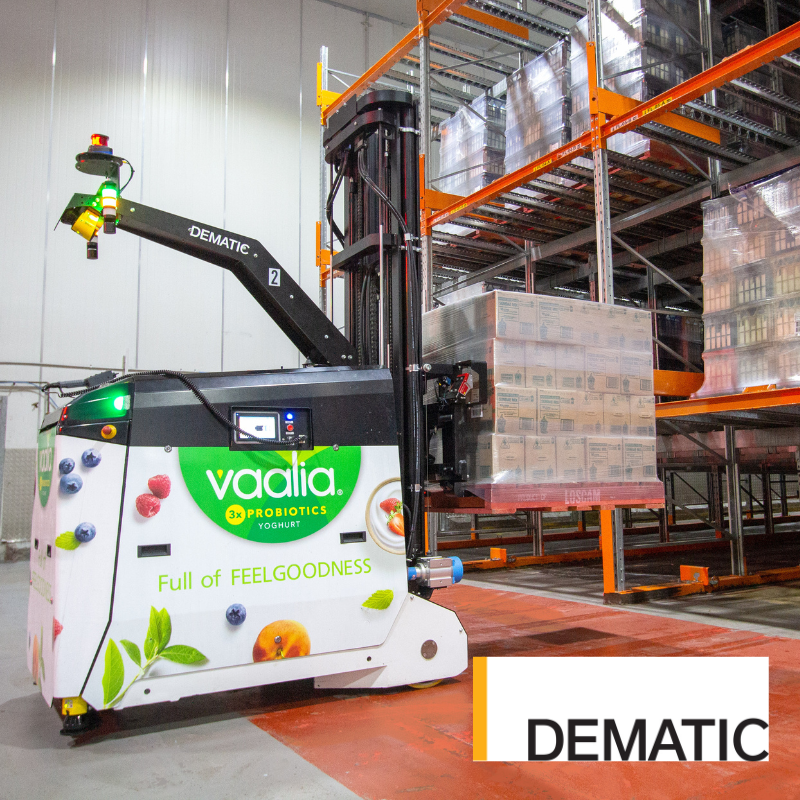
Key areas of automation investment include automated pallet storage, AGV pallet movement, and automated case storage and case picking. The strongest momentum is in automated pallet storage, driven by higher frozen demand, changing dietary trends, and the need for consistent temperature control and traceability.
Over the past 25 years Dematic has witnessed automated pallet storage grow from a minority to the majority of new pallet storage installations in the region. While large 3PLs have historically led this trend, a growing share of investment now comes from producers and processors, metropolitan and regional, implementing scaled-down automated facilities or retrofitting existing warehouses.
These smaller, integrated solutions offer one of the most promising avenues for unlocking capacity without relying solely on new builds.
Brownfield automation is the next step for many
As land becomes harder to secure and construction costs continue to climb, automation suitable for older facilities is receiving more attention.
Solutions like the 4-way pallet shuttle are helping to bring automation into existing and older facilities. The system travels both across aisles and storage channels and between levels, enabling deep-lane storage and significantly increasing density without requiring new building construction. It also offers the flexibility to expand or reconfigure as operational capacity or throughput needs change.
This opens opportunities for operators to extract more value from assets they already own, provided the building meets key structural criteria. Some criteria include sufficient ceiling height, adequate floor load and flatness, available or expandable power, robust insulation and envelope integrity, and transport access that can support higher throughput. These factors help determine whether a retrofit, partial automation, or new build will deliver the strongest return.
Dematic has seen strong uptake of retrofitted automation in Australian cold chain environments, particularly among operators aiming to increase resilience without undertaking full-scale redevelopment.
Where the industry is heading
ANZ’s cold chain is facing ongoing demand growth at a time when infrastructure expansion is becoming more challenging. Capacity constraints, rising energy and other costs, and labour shortages are shaping day-to-day operating decisions across the sector.
Automation is a practical, flexible, and scalable solution to address these pressures. Whether through new builds, targeted retrofits, or shared multi-client facilities, automation is helping operators find capacity, strengthen reliability, and improve operational resilience.
As operators look to optimise new and existing assets and prepare for future demand, a measured and strategic approach to automation will play an increasingly central role in building a resilient cold chain across Australia and New Zealand.