
Many thanks must go to RWTA Member Professor Pierre Pienaar for this article.
Director, PackTech Solutions (Packaging Consulting)
Education Director, Australasian Institute of Packaging
Immediate Past President, World Packaging Organisation

A. Where can packaging make the biggest difference in reducing food waste and improving food security, particularly through the cold supply chain solutions?
Packaging helps most when valuable or perishable food could be damaged, get too warm, or spoil before it reaches grocery stores. This is most likely during transport from farm to shop, handovers in the cold chain, and when food is portioned for eating. Where cold chains are weak or unreliable, 35- 50% of food can be lost during production and distribution. Countries with well-developed supply chains lose much less than developing countries, before food reaches grocery stores
Key areas that packaging can focus on:
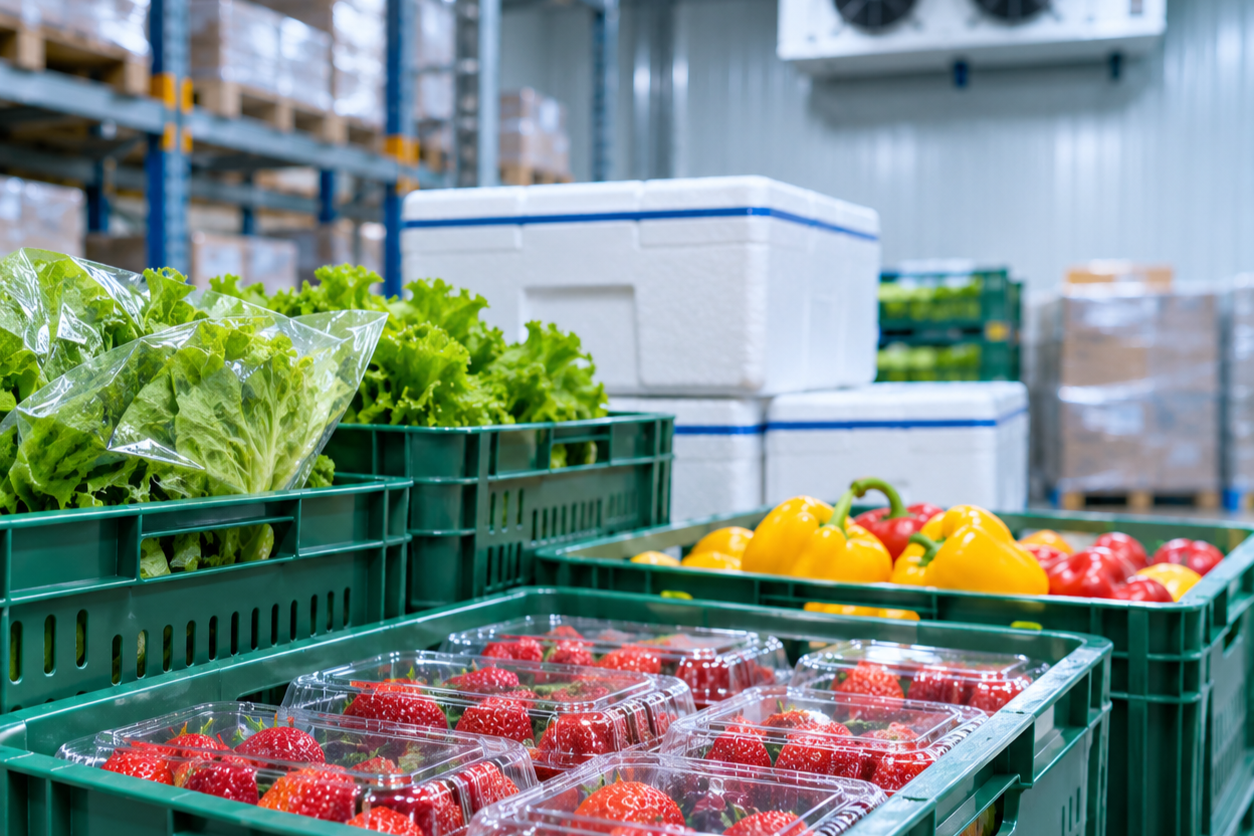
Better protection during transport: Using sturdy, well-ventilated crates that absorb shock prevents produce from being crushed or bruised during the trip from the farm. Since nearly a quarter of Australia’s fresh produce is lost during the production and packing process, reliable packaging is essential to stop this waste.
Keeping the Cold Chain intact: Insulated containers keep food at a steady, cool temperature, even if there are delays during loading or delivery. Using temperature sensors alongside these containers allows for early detection of warming issues, preventing food from spoiling.
Freshness through better Packaging: Specialised packaging can control the air and moisture inside, which slows down ripening and decay. This is particularly helpful for meat, dairy, and fresh produce, as it keeps them fresh for longer, even when consistent refrigeration isn't always available.
Reducing household waste: Providing smaller package sizes for smaller households, along with easy-to-reseal lids and clear "best before" dates, helps consumers use up their food, preventing them from throwing it away unnecessarily.
B. As packaging technology advances, which fundamentals do today's packaging professionals most need to understand and risk overlooking?
While innovations such as smart packaging, sustainable polymers, and high-speed automation are transforming the industry, we often tend to overlook the essential foundations of material science, structural mechanics, and supply chain logistics. Prioritising trends such as embedded sensors or new bioplastics can lead to expensive failures if we neglect the fundamental physics required to protect a product from the factory to the consumer.
-
New compostable films and mono-material plastics are often adopted for sustainability goals without fully accounting for how they interact with the product inside.
Permeation rates: Not enough people working in the industry and who need to make decisions regarding choice of material, fully comprehend oxygen transmission rate (OTR) and moisture vapour transmission rate (MVTR). A slight shift in barrier performance can drastically cut shelf life or ruin product efficacy.
Chemical compatibility: Material interactions, specifically migration (leaching of packaging compounds into the product) and scalping (product-induced degradation of packaging), pose significant risks. These issues are frequently observed in applications involving acidic food products, essential oils, or active pharmaceutical ingredients.
Thermal tolerances: Material performance exhibits significant thermal sensitivity across operating extremes, impacting critical parameters such as heat-seal interfacial integrity during production and the glass transition behaviours that induce embrittlement within cold-chain environments.
-
Simple, lightweight packaging designs often fail to protect items during actual shipping.
Compression and stacking strength: Accurately assessing top-load resistance in corrugated and rigid containers is critical to mitigating compression damage in high-stack and high-humidity environments.
Impact and vibration behaviour: Different transportation modes subject cargo to unique vibration profiles. Failing to test for these resonant frequencies increases the risk of scuffing, loose closures, and structural damage.
Drop and impact resistance: While digital simulations are useful, they often fail to replicate specific transit hazards like corner impacts or cold-weather brittleness. Validating designs through physical protocols like ISTA or ASTM is critical for identifying these failure points.
-
Packaging designs that succeed in a prototype environment often struggle to maintain efficiency during high-speed, automated production.
Three critical factors typically contribute to these failures:
Coefficient of Friction: If labels or films lack the optimal level of 'slip,' they can stick or slide unpredictably, leading to machine jams.
Dimensional Tolerances: Automated lines require high precision. Even slight warping or variations in material stiffness can cause feeding errors that stop the entire production line.
Sealing Requirements: Newer, sustainable materials are often less forgiving than traditional plastics. They require precise temperature and pressure settings, demanding more rigorous machine calibration to ensure a reliable seal."
-
Don't mistake low per-unit packaging costs for true savings; they often hide larger inefficiencies down the line, so keep these three factors in mind:
Maximise space efficiency: If your primary package doesn't fit perfectly into secondary cases and standard pallet configurations (e.g., Australian 1165×1165 mm), one is essentially paying to ship air.
Protect the Bottom Line: Saving pennies by downgrading packaging materials is a net loss if it triggers even a minor spike in shipping damage and product returns.
Be mindful of Regulations: Ignoring recycling capabilities, (future EPR fees), or specific labelling standards (like the Australasian Recycling Label) can lead to expensive fines or force you to scrap and redesign your entire packaging line later.
-
When prioritising tamper-evidence, child-resistance, and material reduction, the end user’s physical experience is too often an afterthought in packaging design
Opening force and dexterity: Packaging that is too difficult to open frustrates consumers, leads to "wrap rage" injuries, and alienates aging demographics.
Clear visual hierarchy: Overcrowding a label with QR codes, sustainability badges, and regulatory text can obscure critical usage instructions, dosage information, or allergen warnings.
C. What skills will the next generation of packaging professionals need to navigate rapidly changing technologies, regulations and expectations?
Future roles will move beyond traditional design and line management, requiring a new approach that connects engineering, compliance, and sustainability across the entire value chain
-
As global mandates like the EU’s PPWR, expanding EPR schemes tighten the system, compliance can no longer be a final "check-the-box" step; it must be central to the design process.
-
Achieving environmental targets without compromising product protection or shelf life requires deep material expertise, focussing on:
Material Selection: Evaluate bio-based alternatives, barrier papers, and lightweight structures, while ensuring safety by eliminating toxic substances like phthalates and BPA.
Data-Driven: Use assessment tools to measure environmental impact, optimise reuse systems, and substantiate sustainability claims to avoid consumer backlash.
-
Automation and digital tools are changing how factories operate and how consumers interact with products, so one needs to focus on the following.
Smarter Operations: Using AI to speed up how we test new materials, predict when machines need repairs, and organise complex compliance information.
Working with Technology: Humans are teaming up with advanced robotics, automated quality-check cameras, and AI assistants built directly into machine controls.
Connected Packaging: Adding tech like QR codes, NFC (Near Field Communication) tags, and digital watermarks to track products through the supply chain, prevent fakes, and give consumers easy recycling instructions.
Conclusion
As the packaging landscape continues to shift under the weight of new regulations and digital integration, the path forward is clear that we must stop treating packaging as an isolated component and start viewing it as a critical pillar of the total value chain.
Success will require us to master the balance between protecting our goods through rigorous physical testing and meeting the high-speed demands of modern automation.
For packaging professionals, the challenge and the opportunity is to remain grounded in the science of protection while boldly embracing the new tools and compliance fluency required to thrive in a circular economy.